Author: lynnhanessian

  • Discipline 2: Establish a Clear Narrative Arc

    Discipline 2: Establish a Clear Narrative Arc

    Structure isn’t decoration. It’s the argument.

    Early in almost every client engagement, I ask the same question: can I see your corporate narrative?

    What arrives next is reliable. A flurry of analyst reports. A deck or two. Messaging documents. Perhaps a recent press release. All of it organized, all of it accurate, and almost none of it a narrative.

    The companies I work with are not careless. They operate in metabolic disease, oncology, immunology, neurology, surgical innovation. They have robust pipelines, decades of accomplishment, and more data than they can use. What they often lack is the throughline: the single, coherent story that explains not just what they have done, but why they exist, where they are going, and why only they can get there.

    In decades of these conversations, almost never has that narrative been considered from the vantage point of the people it needs to move. Not different stories for each stakeholder. One story, told with a shift in emphasis. What the investor needs to understand. What the policymaker needs to feel the weight of. What the patient community needs to believe is possible. One throughline, multiple points of entry. That is not a messaging exercise. It is architecture.

    Which brings us to the test: If a competitor picked up your communications today and presented them as their own, would anyone notice? If the answer is uncertain, what you have is a category description. Not a corporate narrative.

    This is the second discipline of Engagement by Design: before you communicate anything, build the architecture. A narrative without structure is not a story. It is inventory.

    A corporate narrative is not a collection of assets. It is an argument.

    Most organizations approach communications the way a contractor approaches a renovation: they gather the materials first and figure out the structure later. The result is a lot of good material in a room that does not hold together. Impressive on inspection. Incoherent in use.

    When a narrative has no throughline, every communication becomes a separate effort to establish context that should already be shared. Every meeting starts from scratch. Every presentation has to rebuild the case for why the company exists before it can make the case for what it needs. Every stakeholder receives a version of the story shaped by whoever happened to prepare that particular deck.

    The cost is measurable. McKinsey research found that high-performing organizations are nearly three times more likely than others to express their narratives well, and that six of the ten most common leadership regrets relate to communications failures. Stories are significantly more memorable than unstructured information; stakeholders who follow a coherent arc act on what they heard at higher rates than those who were simply informed. That is not a creative finding. It is a strategic one.

    Building a narrative arc means answering three questions before a single word of communications is written.

    Where does the audience start? What do they currently believe about the problem, the company, the field? What assumptions are already in the room before you arrive?

    Where do they need to end up? What shift in belief, in urgency, or in confidence must the communication produce? What has to be true for them to invest, to prescribe, to partner, to act?

    What is the shortest credible path between those two points? That path is the narrative. Not the pipeline. Not the history. The specific argument, including beginning, middle, and end, that moves this audience from where they are to where they need to be.

    The answers to those questions will differ by stakeholder. The investor starts in a different place than the policymaker. The patient advocate carries different assumptions than the clinical partner. A well-built narrative arc accommodates that variation without fracturing into separate stories. The throughline holds. The emphasis shifts. The distinction between adapting emphasis and abandoning coherence is where most communications strategies lose the thread.

    Every asset that does not serve the throughline is a detour. In an attention economy, detours are not just inefficient. They are exits.

    The instinct in healthcare, health tech and biopharma communications is to add. More data, more context, more evidence of rigor. It may feel safer for the communicator, but the audiences bear the cost.

    Structure clarifies, telling the audience what matters, in what order, and toward what conclusion. It does the work of synthesis that most organizations leave to the reader and that most readers, especially those with competing priorities and limited time, will not do.

    Engagement by Design treats narrative architecture as an essential for any engagement strategy. Not a messaging document. A throughline: the argument your audience needs to follow from the first sentence to the call to action. Everything else is built on top of that structure, or it is built on sand.

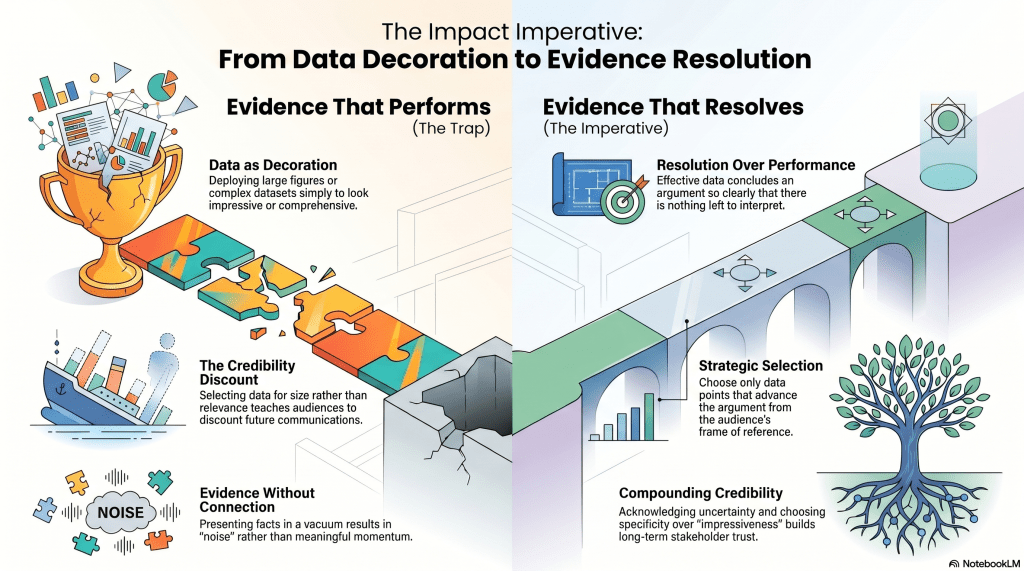
    The Impact Imperative returns to the same measure across every episode: does your engagement strategy produce evidence of impact, or only evidence of effort?

    For narrative arc, the questions are pointed: if someone encountered your latest communications with no prior knowledge of your company, would they come away with a clear picture of who you are, why it matters, and what you want them to do? Or would they come away with a lot of information and no particular direction? Could your investor, your policymaker, and your physician community and patient communities each find themselves in that story without you having to tell a different one for each of them?

    If the answer leans toward no, the architecture is missing. That is where our work together building it begins.

    Lynn Hanessian is the founder of The Engager Company. The Impact Imperative is an eight-part series on the disciplines of Engagement by Design.

  • Discipline 1: Understand Your Audience is Key to Effective Engagement

    Discipline 1: Understand Your Audience is Key to Effective Engagement

    The engagement that never moves anyone doesn’t count.

    In a room of health policy advocates, someone posed a difficult scenario: how would you respond if a critical category of funding were eliminated by an ill-conceived policy proposal? One leader’s response was immediate. I would tell them: Where else are we going to get the resources from? You certainly are not in a position to support us if the proposal becomes law.

    The organizations most committed to their mission are often the ones most certain their stakeholders understand it too. That certainty is not a strength. It is a blind spot, one that tends to surface at the worst possible moment.

    The leader’s perspective was clear: the proposal maker surely understood this organization’s mission, its operations, and the community that depended on it or they would never have put that proposal on the table. Therefore, the policymaker must understand and had simply decided not to care. Another option: the proposal originated from someone who was completely unaware of the importance of the organization’s mission, constituents and funding reality and the harmful impact of their suggestion.

    In either case, the response inverts the problem. If the proposal was informed by what was at stake and who would pay the price, it would never have existed. The issue was not indifference. It was a gap in awareness that no one had thought to close. And a mission-driven organization, so immersed in the urgency of its own work, didn’t start the process by asking whether the people involved had the full picture.

    This is where stakeholder engagement often fails. In the assumption that the knowledge foundation is already there.

    The first discipline of Engagement by Design asks a question most organizations find uncomfortable: not “What do we need to say?,” but “What does our audience actually know, believe, and need before we say anything at all?” The answer is almost always more complicated than expected. Closing that gap systematically is where impact begins.

    Mission-driven organizations are particularly vulnerable to this gap. The very clarity of purpose is often their passion. When you know why your work matters, it is difficult to imagine that someone else does not.

    Economists Camerer, Loewenstein, and Weber named this the “curse of knowledge” in a 1989 study of expert bias (Journal of Political Economy, 97:5): once you understand something deeply, it becomes nearly impossible to reconstruct what it felt like not to know it. That curse compounds over time. The longer an organization has been doing important work, the more invisible its own assumptions can become. The risk: the greater the gap grows between how it sees itself and how it appears to the people whose decisions determine its future.

    The policy scenario reflects this precisely. The leader’s frustration was not unreasonable. But the response, framing the policymaker as indifferent rather than uninformed, points to an engagement strategy headed in the wrong direction rather than one that informs, enlightens and compels positive change. An engagement campaign without the correct starting point and strategy is built to fail.

    Knowing your audience by the numbers is not enough.

    Most organizations have demographics or profiles of their stakeholders. Fewer have mastered what actually drives engagement: a clear picture of where your audience stands in their thinking today and where you need to get them.

    What does this stakeholder believe about this issue today, before you have said a word? What has shaped that belief? What would have to be true for them to act on what you are asking? Which essential inputs will move them to your position? What is their definition of success? These are not marketing questions. They are strategic ones. And they cannot be answered by looking at your mission alone.

    Getting there requires research, landscape understanding, an honest audit of what your stakeholders consider credible, and, what actions will make an impact. For Engagement by Design, this is the belief audit: a structured process that maps the gap between where your audience is and where they need to be, and builds the engagement strategy around the journey to achieving your priorities. The output is not a persona. It is a map of assumptions, resistances, and entry points: the foundation every subsequent engagement campaign depends on.

    In the policy scenario, a belief audit conducted around the proposal would surface its origins and drivers and the stakeholders involved in its origination and those that share your view and motivations to prevent it. It would have identified which key policymakers lacked a working understanding of the organization’s mission, community reach, and funding dependencies, and it would have generated a proactive engagement plan designed to build that understanding before a crisis made it urgent.

    This is the distinction that defines the first discipline: reactive engagement shows up after the room has already gone wrong. Designed engagement builds the foundation before the conversation begins, so that when the critical moment arrives, you are not explaining yourself to people who should already know. You are confirming what they have come to understand through sustained, purposeful engagement. Both skills are needed because unlike film, we can’t be Everything Everywhere All at Once! And whether designed or reactive, your audience strategy must be built on evidence not assumption. That distinction is measurable: in the policy decisions that go your way, in the funding that remains intact, in the relationships that hold when the pressure is highest.

    The question The Impact Imperative returns to every stage is the same: does your engagement strategy produce evidence of impact, or only evidence of effort? Knowing your audience is not a preparation step. It is the first measurable discipline of a strategy built to move people, and the one too often skipped.

    What does your audience actually know about you today? What do they believe? What are they afraid of? If you do not have confident, evidence-based answers to those questions, that is where the work begins and where the impact is waiting. And The Engager Company is here to help.

    Lynn Hanessian is the founder of The Engager Company. The Impact Imperative is an eight-part series on the disciplines of Engagement by Design.

  • Engaging Patients: Skills for Better Healthcare Decisions

    Engaging Patients: Skills for Better Healthcare Decisions

    Here’s what I believe: engagement isn’t just about getting people to use a portal or download an app. It’s about building genuine health literacy and decision-making skills over time. It’s about creating systems that meet people where they are—not where we wish they were.

    This means designing benefits and communications that acknowledge the cognitive load people are already carrying and always equipping them to keep pace with a perpetually evolving system. It means recognizing that a single parent working two jobs doesn’t have time to become an expert in formulary tiers. It means understanding that transparency without education is just noise. This was some of the inspiration for a recent podcast discussion.

    Together with Only Healthcare Podcast founders Randy Vogenberg and Michael Navin, we cover a lot of ground in this episode. From the strain on providers dealing with public health misinformation, to shifting cost and decision making to consumers, to the rise of AI in the hands of patients. If you’re working in employer benefits, health communications, patient advocacy, or healthcare strategy, I think you’ll find some ideas worth considering. Heck, put on some headphones and go for a walk to make it a healthy activity too!

    Listen to the Full Conversation: https://onlyhealthcarepodcast.com/podcast/ep-40-engaging-the-healthcare-consumer-transparency-trust-and-the-skills-we-are-missing/. You can stream the episode wherever you get your podcasts.

    I’d love to hear your thoughts. Are you seeing this skills gap play out in your organization? What’s working—or not working—when it comes to helping people engage with their healthcare decisions? Drop me a note at lynn@engagerco.com

  • JPM26 in Summary: Fat and Mostly Happy

    JPM26 in Summary: Fat and Mostly Happy

    The M&A Machine is Warming Up (Finally)

    Obesity: Still the Main Character

    Hot Zones That Also Carried Weight: Neurology & Oncology

    AI: From Hype Cycle to Deployment Reality

    Hospitals: The Unhappy Exception

    The Undercurrents: What Else Mattered

    The Vibe Check: Recovered, Not Euphoric

  • 2026 Predictions: The Future of Health Care and Trust

    It was a year to remember as health institutions that had been pillars of science and public health were buffeted by change. The impact is growing.

    Attending the GESDA annual summit in Geneva, roiling alongside optimism associated with science discoveries was impact of US cuts made to the WHO and the threats to open science created by political actions. Those racing ahead with advancements intended equitable global benefit, but stymied by growing barriers. Fun fact: China is the global AI leader measured by peer reviewed journal articles and influence. (https://www.digital-science.com/blog/2025/07/new-report-shows-china-dominates-in-ai-research/.) Those rejecting open science may well fall rapidly behind.

    Here in the US, the spread of health misinformation became a feature, not just a fringe activity. With preventable disease outbreaks claiming lives and harming many, making personal health decision when buffeted by competing authorities created burdens for health care providers as patients arrived at appointments questioning why they should get a vaccine and questioning doctors as if they are treating disease to make money.

    There is no doubt that health care cost, access and affordability will be front-and-center in the coming year. Recently released US economic data credited the consumer with the economy’s unexpectedly strong growth. Spending in healthcare led the way. For every dollar spent on health, cars, recreation, food and other consumer goods are in competition for the household budget. Ending ACA subsidies will be watched closely to assess the health and economic impact on families likely least able to take on the increased financial burden.

    The tech transformation of healthcare and the widespread adoption of AI presented promise and worries. Perhaps no topic has transformed more rapidly from SEO to GEO, with health related SEO down 50% as people race to agents for health information and solutions. With wearables detecting health conditions both chronic and acute before the doctor does, the evolution of the doctor/patient relationship now includes a ton of new data.

    In 2026, I will be watching the K-shaped economy closely. (https://www.reuters.com/world/us/us-economic-growth-likely-remained-strong-third-quarter-2025-12-23/) We have long known that there is a haves-and-haves-not divide when it comes to trust and healthcare. Those with more education and income are more likely to trust healthcare vs than those with less. With the rich getting richer and information and financial barriers growing, I predict some will embrace their influencer and social media “care teams” as a replacement for trained healthcare professionals and the dauntingly complex US healthcare system.

    With so much change afoot, it is time to reassess your stakeholders. How have their priorities and expectations changed? What is the foundation of their relationship with your brand? How can you best align your business priorities with their needs? And, are your communications and engagement functions aligned accordingly? Let’s engage!

  • Strategic Engagement: Restoring Faith in Science and Medicine

    Strategic Engagement: Restoring Faith in Science and Medicine

    Science is advancing at breakneck speed. Immense accomplishments today. Immeasurable promise on the horizon. However, healthcare, biopharma, and health tech sectors stand at a critical juncture. The promise of groundbreaking therapies, diagnostics, and life-saving interventions has never been greater. But, beneath this veneer of progress lies a profound challenge: a widening chasm of public trust in science and innovation.

    Major global gatherings, such as the Geneva Science and Diplomacy Anticipator summit, reveal a paradox. Bold advances promise widespread benefits. However, public trust in life transforming science is declining. Today, trust in science can no longer be presumed—the consequences affect health, business, and society.

    Scientific achievements, no matter how profound, struggle for acceptance without intentional, empathetic engagement. As trust fails, clinical trial enrollment stalls, vaccine hesitancy rises, and misinformation drowns out credible science.

    These conditions have been in the making for decades. For scientific and medical communities, delivering health and cures were assumed wins, resulting in the public embraces and confidence. Facts, data, and peer-reviewed studies were believed to be the ultimate arbiters of truth and drivers of acceptance. However, the last decade has laid bare a stark reality: facts alone are insufficient to build and sustain public trust.

    But, there are solutions: A paradigm rooted in strategic communication and genuine engagement. It is both a moral imperative and a critical business advantage. Leaders at the forefront of health and innovation implementing create the foundation for business success.

    The Erosion of Trust: A Multi-Layered Problem

    The decline in public trust in science and healthcare stems from several interconnected factors:

    1. The Information Overload and Misinformation Deluge: The digital age has democratized information. It has also created a fertile ground for misinformation and disinformation. Digital algorithms amplify sensationalism over accuracy. Emotionally charged narratives often outweigh scientifically sound explanations, making it harder to distinguish myth from fact.
    2. Commercialization and Perceived Conflicts of Interest: Health care, medicines and new technologies are multi-billion-dollar industries. While innovation requires investment, this awareness often translates into skepticism about motives. Company profits, drug pricing, and opaque costs contribute to negative narratives that undermine the altruistic aims of medical advancement.
    3. The Slow Pace of Science vs. The Instant News Cycle: The scientific progress is incremental, characterized by hypotheses, experiments, peer review, and often, corrections. It is deliberative, measured and not always linear. This clashes with shortening attention spans and the 24/7 news cycle that features headlines, not thorough and persuasive dialogue.
    4. Historical Injustices and Systemic Inequalities: Many communities, particularly those historically marginalized, distrust medical institutions. This is deeply rooted in past exploitation and ongoing systemic inequalities in healthcare access and quality. This baggage actively shapes present day perceptions.
    5. Swirling Authorities: Changing opinions based on belief are now touted as public health information from US government institutions. This contradicts proven science and fuels conspiracy theories. Eroding trust in institutions leads many to seek information locally. They turn to their doctor, their pharmacist, and their friends and families.

    These factors create an environment where scientific achievements–no matter how breakthrough– struggle to gain broad acceptance.

    The Power of Strategic Communication and Engagement

    To rebuild trust, biotech, pharma, health tech and healthcare organizations must take a proactive approach. They should focus on strategic communication and genuine engagement. We need to rethinking how advance science and engage the public.

    Pillar 1: Humanizing Science and Scientists

    The public doesn’t trust institutions; they trust people:

    • Elevate Authentic Voices: Empower scientists, researchers, and clinical leaders to become articulate, empathetic communicators. Provide media training that focuses on message points, storytelling, active listening, and connecting with diverse audiences on a human level.
    • Share Personal Journeys: Encourage sharing the “why” behind the science. What motivated a researcher to pursue a cure for a rare disease? What personal experiences inform a clinician’s approach to patient care? These narratives build emotional resonance and bridge the gap between complex science and relatable human experience.
    • Community Immersion: Encourage scientists to step outside the lab and engage with local communities—at schools, community centers, and local events. These are opportunities for genuine dialogue, answering questions, and building relationships over time.

    When the public sees the human face of science, familiarity, understanding and appreciation grows.

    Pillar 2: Radical Transparency and Vulnerability

    In an age of skepticism, honesty, even about limitations, is a powerful authenticity:

    • Demystify the Scientific Process: Proactively explain and show how science works. Include the iterative nature of research. Highlight the scientific debate. Help the public understand that uncertainty is a feature, not a bug, of scientific progress.
    • Acknowledge Limitations and Evolution: When scientific understanding evolves (e.g., changes in public health guidance), explain why the recommendations have shifted, based on new data or a deeper understanding. Avoid presenting science as infallible; instead, highlight its self-correcting nature.
    • Plain Language Communication: Eliminate jargon. Use analogies, visuals, and straightforward language to explain complex concepts. Assume no prior knowledge and prioritize clarity over technical precision in public communication. Always with a KISS, Keep It Simple, Stupid.

    Transparency builds credibility. When organizations are open about both successes and challenges, they foster a trust-building environment.

    Pillar 3: Authentic and Inclusive Engagement

    Trust is a two-way street. Genuine engagement means listening as much speaking:

    • Community Advisory Boards (CABs): Establish and empower CABs composed of diverse community members. These boards should have a genuine role in shaping research questions, clinical trial design, and communication strategies. They ensure relevance and cultural appropriateness. Always listen critically as CABs reveal unique perspectives on problems and solutions.
    • Leverage Trusted Messengers: Partner with established, trusted leaders within specific communities (e.g., patient advocates, community organizers, local physicians). Empower these collaborators with accessible scientific information they can share within their networks, bringing their trusted endorsement along with it.
    • Active Listening and Feedback Loops: Create channels for stakeholder feedback and genuinely listen to concerns, questions, and criticisms. Demonstrate that this guidance is valued and shapes how your organization communicates and operates. Address misinformation directly but by providing clear, evidence-based corrections and context.

    Inclusive engagement transforms the public into active participants in the scientific journey, building deep, resilient trust.

    The Business Imperative: Why Trust Matters to Your Bottom Line

    For executives across health care and innovation ecosystems, these are strategic imperatives that directly impact business outcomes:

    1. Accelerated Clinical Trials: Trusted organizations find it easier to recruit diverse patient populations for clinical trials and accelerating drug development
    2. Increased Patient Adoption: Public trust leads to greater acceptance of new therapies, treatments, and health recommendations. This adherence drives better patient outcomes.
    3. Enhanced Brand Reputation and License to Operate: A strong reputation for trustworthiness builds resilience against crises. It also fosters a positive public perception through ethical conduct.
    4. Mitigation of Misinformation and Crisis Resilience: Organizations with established trust are better equipped to combat misinformation and navigate crises.

    Rebuilding trust is urgent—and also an opportunity. At The Engager Company, we design bespoke communication and engagement frameworks. These frameworks help healthcare leaders meet today’s trust challenges. They also unlock business performance.

    Ready to discuss tailored strategies for corporate communications, science communications, launches, or stakeholder engagement? Let’s partner for a trusted future.

  • Doctors, Employers and Trust in Healthcare

    Let’s face it: trust in healthcare is at a crossroads. If it feels harder to build that classic doctor-patient bond, or if navigating your health benefits feels more tricky than ever, you’re not alone. Working with Dr. Jan Berger, we explored this important topic during our Midwest Business Group on Health 45th Annual Conference presentation in May as well as in the newest issue of Chicago Medicine. Happy to share some of our observations and solutions.

    Why is trust in healthcare so fragile right now?

    It wasn’t always this complicated. Back in the day, most doctors ran small practices, building relationships over years and even decades. Now, the system is bigger and more complex. Most
    physicians work for larger organizations, and time is tight. Throw in polarized politics, the legacy of bias, rampant misinformation, and skyrocketing healthcare costs—and it’s no wonder trust is under pressure.

    But here’s the thing: trust isn’t just a warm-and-fuzzy concept. It leads to better health. People who trust their doctors are more likely to get preventive care, follow medical advice, and have better health outcomes. And when trust falters, everyone feels it—patients, doctors, employers, and entire communities.

    So, What’s Getting in the Way?

    • Societal distrust is at an all-time high, and it spills over into healthcare.
    • The politicization of science, financial pressures, and too much noise from unreliable sources on the internet all make things worse.

    Plus, having insurance doesn’t guarantee actual access to care. Many insured patients still avoid getting care (or paying for prescriptions) because it just costs too much. Unsurprisingly, this hits lower-income families the hardest and chips away further at trust.

    Focusing on Solutions: What Can Rebuild Trust?

    Here’s the good news: solutions are within reach, and they’re already having an impact.

    1. Double Down on the Patient-Doctor Relationship

    • Make the most of every interaction. Even with limited time, listening actively and addressing patient concerns honestly lays a foundation of trust.
    • Emphasize consistent follow-through. Predictability and dependability count more than ever.
    • Encourage open communication—let patients know it’s okay to ask questions or bring in information from other sources.
    • Activate hospitals and health systems to foster public health—as trust in institutions has shifted away from national organizations, hospitals and health systems are trusted authorities in “my community” that can share evidence-based health recommendations.

    2. Harness the Power of Employers

    Employers aren’t just benefit-providers; they’re trusted partners. The research shows that, while people may be skeptical of business in general, they often trust their own employer to look out for them.

    • Benefit managers can boost trust by providing clear, transparent information about health plans and coverage.
    • Employers can act as health advocates—working hand-in-hand with doctors to make sure their employees have access to high-value, affordable care.
    • Leading employers are using innovations like value-based care and Centers of Excellence for complex procedures. These programs reward better outcomes, not just more procedures—and they help control costs for everyone.

    3. Increase Transparency and Communication

    • Address financial barriers head-on. Employers and providers should clearly explain the cost of care and support patients in understanding their benefits and options.
    • Demystify the system—transparency about costs, coverage, and available resources decreases frustration and increases faith in the process.
    • Use trusted messengers. Doctors and employers can work together to coordinate clear, honest messaging—through social media, newsletters, and workplace initiatives.

    4. Meet Patients Where They Are

    • Recognize that people get information from everywhere—online, from friends, from local experts. Doctors and employers should join these conversations, sharing accurate information in the channels where people are looking for answers.
    • Frequent, relatable communication from doctors and employers can help cut through misinformation and make health advice feel more personal and trustworthy.

    The Takeaway: Trust Is Everyone’s Job

    Ensuring trust in healthcare takes teamwork from doctors, employers, and patients alike. By nurturing relationships, communicating honestly, advocating for fair and accessible care, and collaborating across the system, trust isn’t just possible—it grows and along with it, personal health.

    The path isn’t easy, but it is clear: every trusted relationship, every honest conversation, every practical support offered, every act of transparency is a step toward a healthcare system that feels safe, credible, and trusted.

  • From Disparities to Equity

    The Center for Healthcare Innovation 13th Annual Health Equity & Innovation Symposium featured rising concerns about fraying health and social systems with expert insights on how to overcome health disparities that weigh heavily on many communities. As a long-time CHI board member, attending the annual gathering was inspirational and energizing, while also serving as a persistent guide on the work we need to do to deliver health equity. Bottomline: Alliances, invitations and storytelling power proven solutions.

    Read more.

  • Myths, Facts and Health

    I was honored to join the DOC debut. Trust in healthcare has gone local because of the erosion of trust in national and global institutions. The Finding Signal in the Noise conversation that kicked off last year is ever urgent today. We have to fill the trust void with fact and evidence-based guidance in the channels where people see information and from trusted advisors. With TikTok is a leading source for news, we need to rethink how and what we communicate along the way. Bravo, DOC, for leading the charge of critical conversations and paths forward.

    Read more.