Category: Narrative Essentials

  • Discipline 6: Keep it concise

    Discipline 6: Keep it concise

    The clock is ticking!

    The best-performing TikToks run 41 seconds. The average peer-reviewed medical journal article runs 4,000 to 7,000 words.

    The average attention span on a digital screen has dropped from 2.5 minutes in 2004 to roughly 47 seconds today. The gap between what audiences can absorb and what organizations produce has widened every year. The organizations still drafting communications for the 2004 attention span are writing for an audience that no longer exists.

    When I work with scientists for presentations and media interviews, the clearest direction I give them is this: flip the abstract upside down. The scientific method builds from methods to conclusions. The attention economy requires the reverse. Lead with what you found. Earn the right to explain how you got there.

    The data on our fleeting attention is compelling. Emails under 100 words generate 51% more responses than emails over 200. Past 300 words, response rates drop to 2.1%. Executives spend less than nine seconds reading an email they have already decided to open.

    Investors, researchers, policy leaders and publics you most need to reach are not information-resistant. They are making constant decisions about which information deserves more of their time. A communication that does not establish its value in the first sentence is not asking for attention. It is asking for charity.

    Too many communications ask for charity.

    Concision must be driven by audience understanding. The discipline is knowing what to remove because you understand what the audience already carries into the room. Their perspective. Their motivation. A clinician who has spent a career treating a patient population does not need epidemiology 101. An investor who has tracked your program for two years does not need the origin story.

    Starting from what they already know is a signal that you value their perspectives and might be worthy of their attention.

    Engagement by Design treats concision as a form of respect. Brevity signals that you understand the audience’s time is not yours to spend. The organizations that earn sustained attention have done the editing before the meeting. They have made the case for why this is worth 60 seconds before asking for an hour.

    ———

    #HealthcareCommunications #Biopharma #EvidenceBasedCommunication #EngagementByDesign #TheImpactImperative

  • Discipline 5: Reach the left brain with evidence wrapped in story delivery vehicle.

    Discipline 5: Reach the left brain with evidence wrapped in story delivery vehicle.

    At the recent American Society of Clinical Oncology annual meeting, a data slide appeared on a screen in a packed convention center hall.

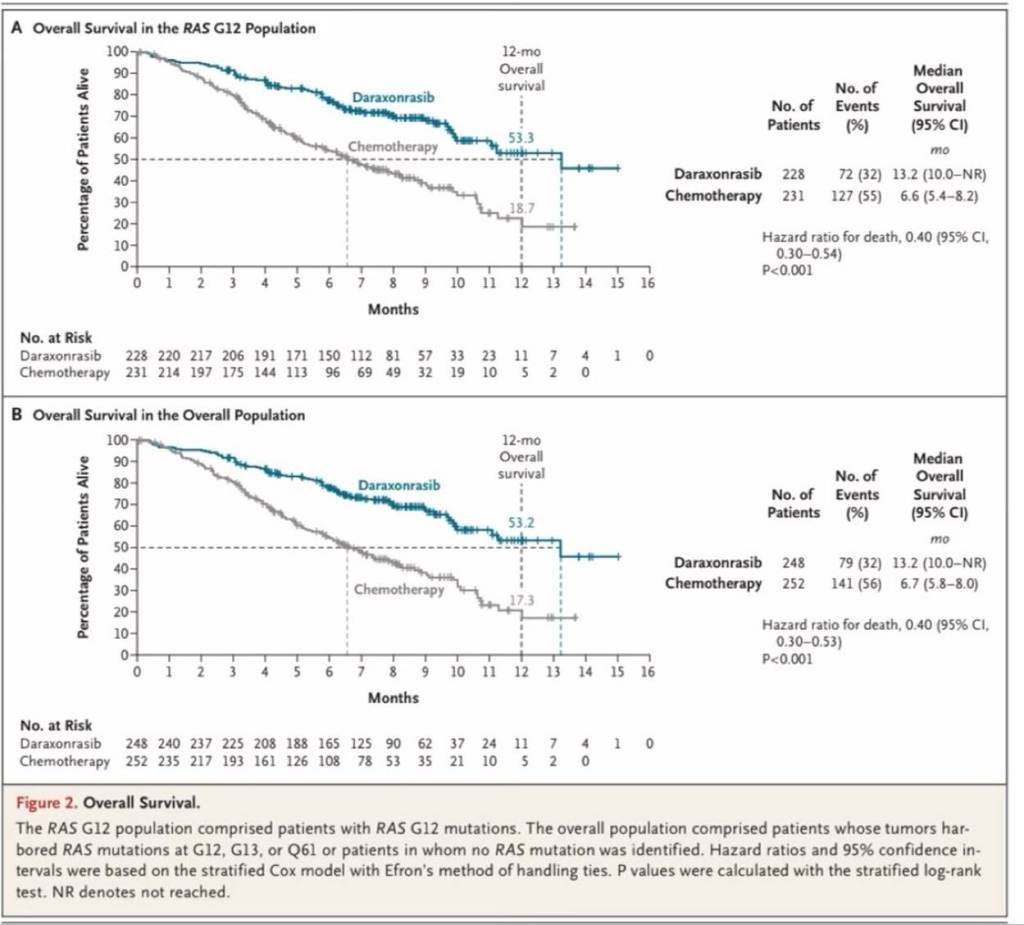
    It was a Kaplan-Meier survival curve. Two lines diverging across a graph: one for patients receiving a new drug in combination with chemotherapy, one for patients on chemotherapy alone. This is the kind of visualization oncologists encounter dozens of times a year.

    The packed convention center room stood up. Some had tears in their eyes.

    The drug was daraxonrasib, developed by Revolution Medicines for patients with RAS-mutated pancreatic cancer. The disease is lethal: just 3% of patients with metastatic pancreatic cancer survive five years after diagnosis. The RAS protein that drives more than 90% of these cancers had been called “undruggable” for decades. Years of attempts failed to effectively target it.

    The Phase 3 results: median overall survival of 13.2 months for patients receiving daraxonrasib combined with chemotherapy, compared with 6.7 months for patients on chemotherapy alone. At twelve months, 53% of daraxonrasib patients were alive, compared with 17% of those on chemotherapy. The results were published in the New England Journal of Medicine as the slide projected in the hall. The FDA had already fast-tracked approval and expanded access to patients outside clinical trials made available for free.

    Every oncologist attending the meeting already knew the data before it appeared on the screen. The abstract had been published in April. Media had covered the results already. NBC News called it a watershed moment a month before the presentation.

    But, knowing what they would see, they stood up anyway.

    The question is not what data do we have. It is what does this audience need to see in order to be unable to unsee it.

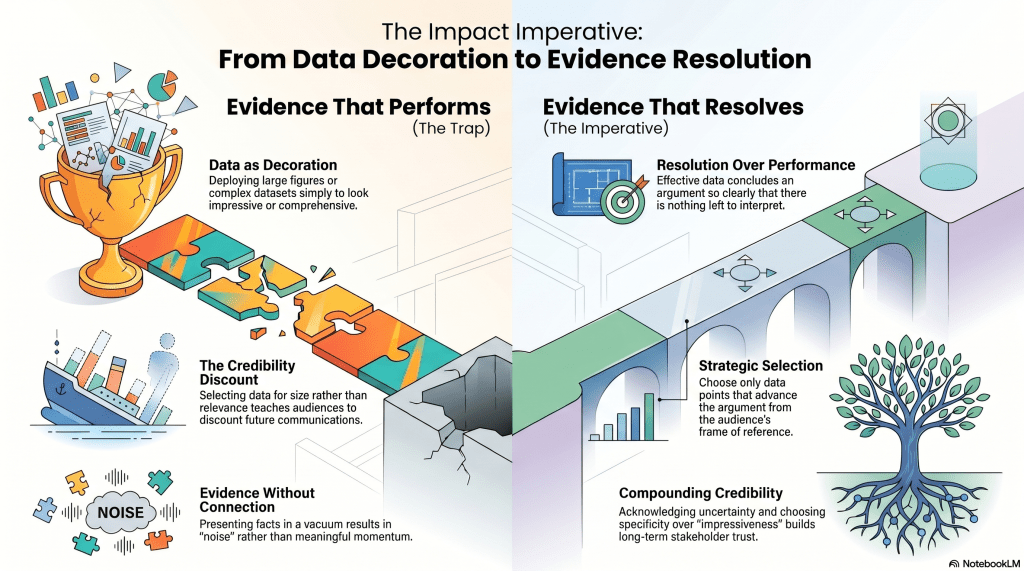
    Evidence That Resolves Rather Than Informs

    Emotional connection without evidence is anecdote. Evidence without emotional connection is noise. The discipline is knowing when to lead with which, and how to integrate them so that momentum builds.

    What made the daraxonrasib curve move a room full of stoic clinicians? Not novelty. The audience already knew the numbers. What moved them was context. The decades of failure that preceded it. The patients who had run out of options. The science that had finally worked where every previous attempt had not.

    The data did not arrive in a vacuum. It arrived at the conclusion of an argument the entire field had been making for years. When that survival curves appeared on the screen, it resolved the argument rather than simply restating it. There was nothing left to interpret.

    That is what precision in science presentation achieves. Not performance. Resolution.

    Evidence That Performs vs. Evidence That Persuades

    Most organizational communications deploy evidence the way convention centers deploy signage: to mark the territory, not to move anyone through it.

    A company announces a milestone and includes a market size figure because the number is large. A clinical team presents a dataset and adds three supplementary datasets for comprehensiveness. A policy argument is made and citations are appended below it. The evidence is present. The argument never arrives.

    Engagement by Design embraces evidence-based communications, but the discipline is not about volume. It is about selection. Every claim anchored. Every certainty level calibrated. Every data point chosen because it advances the argument rather than decorates it. It is coordinated narrative arc delivering an experience that is quite like an opera. The integration of multiple arts strategically designed to produce a magnificent, impactful experience. Narrative and data points that spark excitement all over the brain.

    For the oncologists at ASCO, the right evidence was two lines on a graph. Demonstrably separated from month one. Thirteen months survival versus seven. Fifty-three percent versus seventeen as twelve months. And the weight of everything that had been tried before. The room filled with careers understanding why those numbers were impossible. The curves included in the accompanying NEJM publication will tell the story for many years to come:

    Credibility That Compounds

    There is a longer argument for strategic science and evidence-based communication that extends beyond any single presentation.

    Stakeholders who trust your evidence base return to you when the stakes are highest. The organization that has shown it understands certainty levels, that it does not overstate, that it acknowledges what is not yet known, that it chooses specificity over impressiveness, builds credibility that compounds over time. It is not simply believed in the moment. It is the first call when the next decision needs to be made.

    The inverse is equally true. An organization that reaches for evidence that performs, that selects data for its size rather than its relevance, that adds citations without regard to the context, teaches its audience to discount what it says. That discount applies to every future communication.

    The ASCO debut was the culmination of years of rigorous science and clinical development, each stage held to the same standard: show what is true, show what it means, show what it changes. By the time the slide appeared, the room was prepared to believe it.

    That preparation is the work.

    The Question to Ask Before the Next Data Communication

    The Impact Imperative returns to the same standard across every episode: does your engagement strategy produce evidence of impact, or only evidence of effort?

    For evidence-based engagement, the questions are direct. Does each data point advance the argument, or does it simply occupy space? Has the evidence been chosen from the audience’s frame of reference, what they already know, what they have been unable to solve, what failure looked like before? Could a person in your audience reconstruct the argument from the evidence alone?

    If the honest answer leans toward decoration, the left brain has been left out of the room.

    That is where our work together begins.

  • Discipline 4: Use the right brain to engage people, not institutions

    Discipline 4: Use the right brain to engage people, not institutions

    When making a fact-based appeal, many leaders pursue data and evidence as the foundation of their argument: in support of a new innovation, a change in clinical approach, or a policy position. These are essential, but usually not enough to be persuasive.

    What gets neglected is that the people receiving those arguments are also human beings. Not just decision-makers or doctors or future partners. They are people. People who carry professional and personal context into every room, who have feelings about the problem before any data arrives. They are moved not only by the evidence, but are also deeply impacted by all of us the personal and the real world implications.

    Bruce Japsen, a seasoned healthcare reporter and Forbes Senior Healthcare Contributor, was recently interviewed on NPR about the impact of cuts to Affordable Care Act subsidies. His expert perspective is anchored in decades of reporting. The data was clear: rising consumer costs, millions dropping off insurance rolls, businesses exiting care markets. All clear and relevant to those focused on the business of healthcare.

    Bruce then brought the whole topic to life–moving from evidence to emotion. Japsen described a recent conversation with a man in his forties. He had lost his job. He had been purchasing health insurance through the ACA marketplace. With the loss of subsidies, and still unemployed, he faced a cataclysmic premium increase.

    One person and his specific situation. That detail did not add information the audience did not already have. It did, however, activate the evidence in a way that the data cannot achieve on its own.

    The evidence establishes the argument. The person makes it matter.

    Why Data Is Not the Panacea You Think It Is

    The assumption embedded in most health and science communications is that sophisticated audiences are primarily moved by evidence. This is not wrong. The absence of it is disqualifying. There can be nothing like a powerful P value.

    But evidence is not the engine of behavior change. It is the threshold. It establishes credibility and earns the right to be heard. And it has to be done well. (Watch for a future post from me on this front.) Once it has done that work, something else has to do the rest.

    The leaders, clinicians, investors, and policymakers you most need to reach are not, in most cases, data-resistant. They are data-saturated, with each new data point diluting in its impact. They are time stressed like many of us—so much so that few move beyond an abstract with reviewing the latest publications. The executive who has reviewed three hundred market analyses does not feel urgency from the three hundred and first. The clinician who has read fifty trial reports is not moved by the fifty-first in a way that changes what they do on Monday morning.

    In an environment of saturation, additional data does not close the gap between understanding and action. A different kind of input does.

    What the Human Story Actually Does

    A patient story, or any story anchored in a specific person’s experience, is not decoration. Human story does something evidence cannot: it makes the abstract specific.

    The audience that hears a statistic is processing a probability. The audience that meets the person behind the statistic is doing something different. They are encountering a human situation. Behavioral science research consistently shows that people respond to identified individuals at rates that bear no relationship to the statistical significance of the group those individuals represent. We act on behalf of the person in front of us in ways we simply do not act on behalf of populations, regardless of how large or how well-documented those populations are. It becomes personal.

    This is how human attention and motivation function. And it applies with equal force to physicians, investors, regulators, and policymakers as it does to any other audience. The sophistication of the role does not override the humanity of the person in it.

    Emotional Resonance as a Design Requirement

    Engagement by Design does not treat emotional connection as a complement to evidence-based communication. It treats it as a design requirement.

    This is not a case for sentiment over science. The evidence is the foundation. The human story is the architecture that makes the foundation matter to someone. The patient story is not a nice to have. It is ever-more important to breakthrough the swirl of daily lives. Data without story leaves the audience knowing and not acting. Story without data leaves the audience moved but not convinced. The discipline is in the integration: knowing when to lead with which, and how to build the argument so that each element reinforces the other rather than competing with it.

    I am working on a project exploring how to change clinical practice to align with evidence-based guidelines in cancer care. One expert on the project made a recommendation: include a patient story. Specifically, the experience of a person whose one-in-ten condition made her eligible for a new medicine. Ten percent may not sound like much. The patient’s voice brings a level of reality that changes the impact of the statistics. A person living a fulfilling life makes a one hundred percent impact on the dedicated physicians involved in her care.

    That is the shift. Not from ten percent to one hundred percent in any statistical sense. From a probability to a person. And that shift changes what a clinician does next.

    The Question to Ask Before the Next Communication

    The Impact Imperative returns to the same standard across every episode: does your engagement strategy produce evidence of impact, or only evidence of effort?

    For emotional resonance, the questions are direct. Are you asking your audience to understand a probability, or to meet a person? Is the human dimension of your science, your innovation, or your program visible in your communication, or is it implied somewhere in the data? When someone finishes reading what you have sent them, do they understand what it means for a specific person, or only what it means in aggregate? If the honest answer leans toward aggregate, the right brain has been left out of the room.

    That is where our work together begins.

  • Discipline 2: Establish a Clear Narrative Arc

    Discipline 2: Establish a Clear Narrative Arc

    Structure isn’t decoration. It’s the argument.

    Early in almost every client engagement, I ask the same question: can I see your corporate narrative?

    What arrives next is reliable. A flurry of analyst reports. A deck or two. Messaging documents. Perhaps a recent press release. All of it organized, all of it accurate, and almost none of it a narrative.

    The companies I work with are not careless. They operate in metabolic disease, oncology, immunology, neurology, surgical innovation. They have robust pipelines, decades of accomplishment, and more data than they can use. What they often lack is the throughline: the single, coherent story that explains not just what they have done, but why they exist, where they are going, and why only they can get there.

    In decades of these conversations, almost never has that narrative been considered from the vantage point of the people it needs to move. Not different stories for each stakeholder. One story, told with a shift in emphasis. What the investor needs to understand. What the policymaker needs to feel the weight of. What the patient community needs to believe is possible. One throughline, multiple points of entry. That is not a messaging exercise. It is architecture.

    Which brings us to the test: If a competitor picked up your communications today and presented them as their own, would anyone notice? If the answer is uncertain, what you have is a category description. Not a corporate narrative.

    This is the second discipline of Engagement by Design: before you communicate anything, build the architecture. A narrative without structure is not a story. It is inventory.

    A corporate narrative is not a collection of assets. It is an argument.

    Most organizations approach communications the way a contractor approaches a renovation: they gather the materials first and figure out the structure later. The result is a lot of good material in a room that does not hold together. Impressive on inspection. Incoherent in use.

    When a narrative has no throughline, every communication becomes a separate effort to establish context that should already be shared. Every meeting starts from scratch. Every presentation has to rebuild the case for why the company exists before it can make the case for what it needs. Every stakeholder receives a version of the story shaped by whoever happened to prepare that particular deck.

    The cost is measurable. McKinsey research found that high-performing organizations are nearly three times more likely than others to express their narratives well, and that six of the ten most common leadership regrets relate to communications failures. Stories are significantly more memorable than unstructured information; stakeholders who follow a coherent arc act on what they heard at higher rates than those who were simply informed. That is not a creative finding. It is a strategic one.

    Building a narrative arc means answering three questions before a single word of communications is written.

    Where does the audience start? What do they currently believe about the problem, the company, the field? What assumptions are already in the room before you arrive?

    Where do they need to end up? What shift in belief, in urgency, or in confidence must the communication produce? What has to be true for them to invest, to prescribe, to partner, to act?

    What is the shortest credible path between those two points? That path is the narrative. Not the pipeline. Not the history. The specific argument, including beginning, middle, and end, that moves this audience from where they are to where they need to be.

    The answers to those questions will differ by stakeholder. The investor starts in a different place than the policymaker. The patient advocate carries different assumptions than the clinical partner. A well-built narrative arc accommodates that variation without fracturing into separate stories. The throughline holds. The emphasis shifts. The distinction between adapting emphasis and abandoning coherence is where most communications strategies lose the thread.

    Every asset that does not serve the throughline is a detour. In an attention economy, detours are not just inefficient. They are exits.

    The instinct in healthcare, health tech and biopharma communications is to add. More data, more context, more evidence of rigor. It may feel safer for the communicator, but the audiences bear the cost.

    Structure clarifies, telling the audience what matters, in what order, and toward what conclusion. It does the work of synthesis that most organizations leave to the reader and that most readers, especially those with competing priorities and limited time, will not do.

    Engagement by Design treats narrative architecture as an essential for any engagement strategy. Not a messaging document. A throughline: the argument your audience needs to follow from the first sentence to the call to action. Everything else is built on top of that structure, or it is built on sand.

    The Impact Imperative returns to the same measure across every episode: does your engagement strategy produce evidence of impact, or only evidence of effort?

    For narrative arc, the questions are pointed: if someone encountered your latest communications with no prior knowledge of your company, would they come away with a clear picture of who you are, why it matters, and what you want them to do? Or would they come away with a lot of information and no particular direction? Could your investor, your policymaker, and your physician community and patient communities each find themselves in that story without you having to tell a different one for each of them?

    If the answer leans toward no, the architecture is missing. That is where our work together building it begins.

    Lynn Hanessian is the founder of The Engager Company. The Impact Imperative is an eight-part series on the disciplines of Engagement by Design.


  • Engaging Patients: Skills for Better Healthcare Decisions

    Engaging Patients: Skills for Better Healthcare Decisions

    Here’s what I believe: engagement isn’t just about getting people to use a portal or download an app. It’s about building genuine health literacy and decision-making skills over time. It’s about creating systems that meet people where they are—not where we wish they were.

    This means designing benefits and communications that acknowledge the cognitive load people are already carrying and always equipping them to keep pace with a perpetually evolving system. It means recognizing that a single parent working two jobs doesn’t have time to become an expert in formulary tiers. It means understanding that transparency without education is just noise. This was some of the inspiration for a recent podcast discussion.

    Together with Only Healthcare Podcast founders Randy Vogenberg and Michael Navin, we cover a lot of ground in this episode. From the strain on providers dealing with public health misinformation, to shifting cost and decision making to consumers, to the rise of AI in the hands of patients. If you’re working in employer benefits, health communications, patient advocacy, or healthcare strategy, I think you’ll find some ideas worth considering. Heck, put on some headphones and go for a walk to make it a healthy activity too!

    Listen to the Full Conversation: https://onlyhealthcarepodcast.com/podcast/ep-40-engaging-the-healthcare-consumer-transparency-trust-and-the-skills-we-are-missing/. You can stream the episode wherever you get your podcasts.

    I’d love to hear your thoughts. Are you seeing this skills gap play out in your organization? What’s working—or not working—when it comes to helping people engage with their healthcare decisions? Drop me a note at lynn@engagerco.com

  • Doctors, Employers and Trust in Healthcare

    Let’s face it: trust in healthcare is at a crossroads. If it feels harder to build that classic doctor-patient bond, or if navigating your health benefits feels more tricky than ever, you’re not alone. Working with Dr. Jan Berger, we explored this important topic during our Midwest Business Group on Health 45th Annual Conference presentation in May as well as in the newest issue of Chicago Medicine. Happy to share some of our observations and solutions.

    Why is trust in healthcare so fragile right now?

    It wasn’t always this complicated. Back in the day, most doctors ran small practices, building relationships over years and even decades. Now, the system is bigger and more complex. Most
    physicians work for larger organizations, and time is tight. Throw in polarized politics, the legacy of bias, rampant misinformation, and skyrocketing healthcare costs—and it’s no wonder trust is under pressure.

    But here’s the thing: trust isn’t just a warm-and-fuzzy concept. It leads to better health. People who trust their doctors are more likely to get preventive care, follow medical advice, and have better health outcomes. And when trust falters, everyone feels it—patients, doctors, employers, and entire communities.

    So, What’s Getting in the Way?

    • Societal distrust is at an all-time high, and it spills over into healthcare.
    • The politicization of science, financial pressures, and too much noise from unreliable sources on the internet all make things worse.

    Plus, having insurance doesn’t guarantee actual access to care. Many insured patients still avoid getting care (or paying for prescriptions) because it just costs too much. Unsurprisingly, this hits lower-income families the hardest and chips away further at trust.

    Focusing on Solutions: What Can Rebuild Trust?

    Here’s the good news: solutions are within reach, and they’re already having an impact.

    1. Double Down on the Patient-Doctor Relationship

    • Make the most of every interaction. Even with limited time, listening actively and addressing patient concerns honestly lays a foundation of trust.
    • Emphasize consistent follow-through. Predictability and dependability count more than ever.
    • Encourage open communication—let patients know it’s okay to ask questions or bring in information from other sources.
    • Activate hospitals and health systems to foster public health—as trust in institutions has shifted away from national organizations, hospitals and health systems are trusted authorities in “my community” that can share evidence-based health recommendations.

    2. Harness the Power of Employers

    Employers aren’t just benefit-providers; they’re trusted partners. The research shows that, while people may be skeptical of business in general, they often trust their own employer to look out for them.

    • Benefit managers can boost trust by providing clear, transparent information about health plans and coverage.
    • Employers can act as health advocates—working hand-in-hand with doctors to make sure their employees have access to high-value, affordable care.
    • Leading employers are using innovations like value-based care and Centers of Excellence for complex procedures. These programs reward better outcomes, not just more procedures—and they help control costs for everyone.

    3. Increase Transparency and Communication

    • Address financial barriers head-on. Employers and providers should clearly explain the cost of care and support patients in understanding their benefits and options.
    • Demystify the system—transparency about costs, coverage, and available resources decreases frustration and increases faith in the process.
    • Use trusted messengers. Doctors and employers can work together to coordinate clear, honest messaging—through social media, newsletters, and workplace initiatives.

    4. Meet Patients Where They Are

    • Recognize that people get information from everywhere—online, from friends, from local experts. Doctors and employers should join these conversations, sharing accurate information in the channels where people are looking for answers.
    • Frequent, relatable communication from doctors and employers can help cut through misinformation and make health advice feel more personal and trustworthy.

    The Takeaway: Trust Is Everyone’s Job

    Ensuring trust in healthcare takes teamwork from doctors, employers, and patients alike. By nurturing relationships, communicating honestly, advocating for fair and accessible care, and collaborating across the system, trust isn’t just possible—it grows and along with it, personal health.

    The path isn’t easy, but it is clear: every trusted relationship, every honest conversation, every practical support offered, every act of transparency is a step toward a healthcare system that feels safe, credible, and trusted.

  • From Disparities to Equity

    The Center for Healthcare Innovation 13th Annual Health Equity & Innovation Symposium featured rising concerns about fraying health and social systems with expert insights on how to overcome health disparities that weigh heavily on many communities. As a long-time CHI board member, attending the annual gathering was inspirational and energizing, while also serving as a persistent guide on the work we need to do to deliver health equity. Bottomline: Alliances, invitations and storytelling power proven solutions.

    Read more.

  • Myths, Facts and Health

    I was honored to join the DOC debut. Trust in healthcare has gone local because of the erosion of trust in national and global institutions. The Finding Signal in the Noise conversation that kicked off last year is ever urgent today. We have to fill the trust void with fact and evidence-based guidance in the channels where people see information and from trusted advisors. With TikTok is a leading source for news, we need to rethink how and what we communicate along the way. Bravo, DOC, for leading the charge of critical conversations and paths forward.

    Read more.